

The Boss of the Lord Leycester
In 1383 a group of men were licensed to found a guild in honour of the Holy Trinity and St. Mary in St. Mary’s Church. Among them were nine past and future members of Parliament for Warwick, and they were headed by William Hobkyns. Thomas Beauchamp, the 12th Earl of Warwick, and his brother had sought the licence on their behalf, and it cost the new master and brethren £26 13s. 4d. The guild was empowered to acquire property to the value of £20 a year in order to support three chaplains in the church, but it seems most likely that the founders had wider purposes in mind; It may well be that the Guild of the Holy Trinity and St. Mary was from the first intended to take responsibility for the maintenance of the bridge, which some of its founder-members had already assumed. Certainly, when the Guild of Warwick was surveyed prior to its dissolution, part of its income was being used for the upkeep of the bridge and of the highways ‘thereabout’.
On 20th April in the same year, 1383, a second guild was founded by three men of whom nothing else is known; it was to consist of themselves and the burgesses of Warwick and was in honour of St. George the Martyr, under licence from King Richard II.. The licence cost them £53 6s. 8d.; it authorised property worth £10 a year to be acquired to support two chaplains in St. James’s Chapel.
St. James Chapel was rebuilt in 1383 by Thomas Beauchamp, the 12th Earl of Warwick – one of the Lords Appellant who opposed Richard II. When Thomas Beauchamp met with the usual fate of men who opposed kings, the chapel was gifted to the Guild of St George.
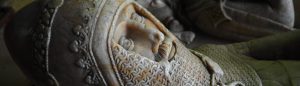
Grave of Thomas Beauchamp in Beauchamp Chapel, St Mary’s Church.
Between 1392 and 1415 they were amalgamated as the Guild of Holy Trinity and St. George, often known simply as the Guild of Warwick.
The purpose of the guilds expanded to take in commerce. New businessmen had to complete 7-year apprenticeships before they could start their business. The Guilds controlled all apprenticeships in the town, ostensibly to maintain quality of goods made. The guildsmen and Master became very influential in the running of the town. The position of the guild in town affairs is reflected in the pre-eminence accorded to the master in 15th-century deeds, where his name precedes those of the bailiffs in witness lists.
Living quarters and public rooms were added to the chapel including the Great Hall.[5] These form the courtyard of the Lord Leycester that we see today. By the 15th century the chapel and the associated site belonged to the amalgamated guilds of Warwick – the Holy Trinity Guild and the Guild of the Blessed Virgin and St George. The United Guilds created a large complex of buildings. The current guildhall was built in 1450 by Richard Neville a.k.a. The Kingmaker, who was 16th Earl of Warwick.
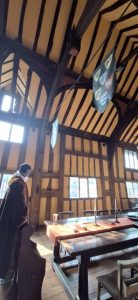
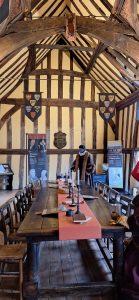
Pictures of the Guildhall as it is found today.
Dissolution of The Guilds of Warwick.
Once the Reformation under King Henry VIII began, many guilds lost their lands to the crown, but in Warwick Thomas Oken, Master of the Guilds, foresaw this and cleverly passed ownership of the property owned by the Guilds of Warwick, and the associated rental from as far afield as Gloucester and Lancaster to the Burgesses of Warwick. This meant that the income continued to be used for the benefit of Warwick rather than the king after the United Guilds of Warwick were dispersed by King Henry VIII in 1546.
So, the guild ended its life with a rare flourish which is further evidence of its interest in the affairs of the town. In 1545 it sold part of its property and used the money to promote the establishment of St. Mary’s on a new footing, closely associated with the new grammar school, and later gave money and its hall to the newly incorporated burgesses, presumably its own members in another guise. With the charter of 1545 and, more especially, that of 1554 Warwick took its first decisive steps towards corporate self-government.
Thomas Oken, “The Boss”.
Thomas Oken lived in Warwick during the reigns of Henry VII, Henry VIII, Edward VI, Mary I and Elizabeth I, a period of great religious change with all the social upheaval that this brought in its wake. He was a silk merchant – a self-made man, who was married but without children who left his fortune to good causes.
A mercer, who made a comfortable fortune, he devoted his talents to the service of his town and his fellow citizens. He was a public-spirited man, heavily involved in local government and of deep religious conviction. He was the last Master of the Guild of Holy Trinity and St George, which was dissolved in 1546.
Between Michaelmas 1544 and May 15th, 1545, the date of the grant of the municipal charter to Warwick, he conducted the difficult negotiations with Henry VIII’s Commissioners which secured for the people of Warwick a substantial part of the Church and Guild endowments, thereby preventing the worst effects of subsequent legislation by the Crown.
He became one of the principal Burgesses named in the Charter and was Bailiff from 1557 – 1558 remaining a member of the Corporation until his death on July 29th, 1573.
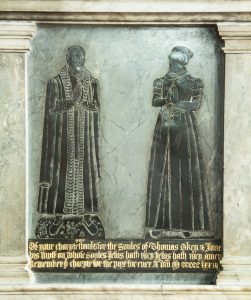
Thomas Oken was married (to Joan) but died childless and left his personal fortune to the town. He is commemorated in St Mary’s church.
In his will, from his personal fortune, he arranged amongst other things, for the payment of the salary of the schoolmaster, annual payments to “the poor”, the paving of certain streets, the repairing of the bridge, the wages of the herdsmen and the beadle, the repairing of the wells, and the provision of the almshouses for six people. Such provisions as are applicable today are carried out by Oken’s Charity including the building and maintenance of the almshouses.
He also provided for the spending of £1 annually on a feast which, perhaps, he meant to be continuance of the Guild Feast, preceded as that had been by a service at St. Mary’s. The tradition is continued on the last Friday in January each year.
A chest belonging to Thomas Oken still exists, and stands in the corner of the Council Chamber at the Court House (the building that houses the Visitor Information Centre on the corner of Castle Street and Jury Street). The chest was restored in 1851 and painted with the town’s arms and Thomas Oken’s initials.
The five plate locks and clasps and staples for four padlocks meant that the chest could only be opened in the presence of all the key holders – all members of the Corporation. It would have contained a lot of money and confidential documents.
The Origin of “Boss”
The original dictionary definition of the word “boss” is “a raised rounded decoration” such as on a shield or a ceiling.
In medieval architecture, a boss is a stone or timber knob or protrusion, most commonly found in ceilings, forming the junction between the intersecting ribs. The original purpose of the surface decoration was to conceal the complex mitred joints.
In grand buildings, such as cathedrals with gothic architecture, roof bosses (or ceiling bosses) are often intricately carved with foliage, heraldic devices or other decorations.
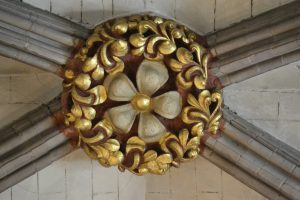
A boss found at Hereford Cathedral
The table found in the centre of the Guildhall is thought to have been the original table used by the United Guilds of Warwick where they discussed matters such as trade, religion and politics. In those days the position you sat in at the table was literally your position in society.
So, Thomas Oken, as Guild Master, would have sat at the head of the table. This is sited under a prominent and decorated piece of wood, known as a boss. And so, the person sitting in the seat positioned under the boss in the ceiling became known colloquially as The Boss.
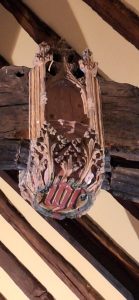
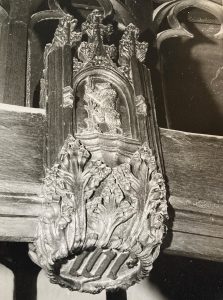
A side by side of a medieval boss at the Lord Leycester Hospital with a more recent picture compared to an older picture.
By the 17th Century the Dutch form “baas” is recorded in English as the standard title of a Dutch ship’s captain. The word baas and its meaning was taken to USA by Dutch settlers and brought into English via the Dutch settlements of New Netherlands along the Hudson River valley in what is now New York. The word’s popularity in U.S. may reflect egalitarian avoidance of master as well as avoiding reference to slaving where work-master /slave-master was commonly used.
Refs.
The borough of Warwick: Political and administrative history to 1545 | British History Online
History – The Charity of Thomas Oken and Nicholas Eyffler
Boss (medieval architecture) – Designing Buildings
boss, n.¹ meanings, etymology and more | Oxford English Dictionary