The Gardens
The gardens of the Lord Leycester offer two acres of green space in the heart of Warwick, but beneath their lawns, borders and pathways lies an extraordinary part of the town’s history.
Running along the western edge of the gardens is the last surviving stretch of Warwick’s ancient town wall outside its historic gatehouses. The earliest defences were established in the 10th century under Æthelflæd, Lady of Mercia, with the later stone walls dating from the years following the Norman Conquest.
Rising several metres above the High Street below, the gardens look out across the west of Warwick from the top of these ancient defences. Their continued use by the Lord Leycester for more than five centuries has helped preserve this remarkable surviving piece of medieval Warwick.
A Greensward for the Brethren
Gardens have formed part of life at the Lord Leycester since long before its foundation as an almshouse.
When Robert Dudley, Earl of Leicester, established the Lord Leycester in 1571, he ensured that the gardens remained for the use of the Brethren “as a greensward for recreation”, providing the resident veterans with somewhere to relax, grow produce and enjoy the outdoors.
More than 450 years later, the gardens remain at the heart of the community.
The gardens visitors see today were largely designed during the 1990s by Susan Rhodes, wife of former Master Dermot Rhodes, bringing together centuries of history with planting and landscaping inspired by the site’s remarkable surroundings.
The main gardens are divided into three distinct areas, each with its own character and history.
The Master’s Garden
Backing onto the Master’s House, the Master’s Garden is the largest and most open of the three spaces, with a broad lawn surrounded by Victorian-inspired planting and mature trees.
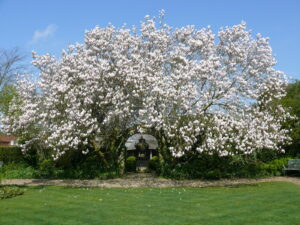
Among its most impressive features is a magnificent magnolia tree, which fills the garden with colour when in bloom.
The garden is also home to the Pathway of Support, where engraved plaques commemorate individuals and organisations whose generosity has helped support the Lord Leycester, its Brethren and the preservation of the historic site.
A resin-bound pathway runs through the garden, providing wheelchair access and allowing visitors to enjoy the space and its views across Warwick.
The Brethren’s Garden
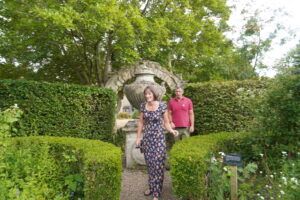
Passing through an original Norman archway, once believed to have formed part of Warwick’s West Gate, visitors enter the Brethren’s Garden.
At its centre is a traditional Tudor-inspired knot garden, divided into four sections growing vegetables, fruit, herbs and cottage flowers – reflecting the long relationship between the gardens and the community who have lived here.
The surrounding borders are filled with flowers and climbing roses, while one of the garden’s most unusual features is an ancient Egyptian Nilometer, around 2,000 years old and gifted to the Lord Leycester from Warwick Castle.
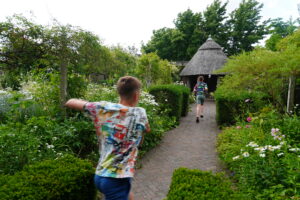
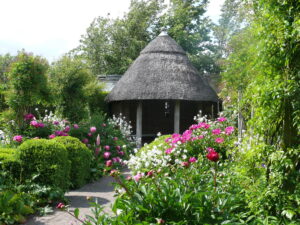
Nearby stands the thatched summerhouse. Thatch became a rare sight in Warwick following the Great Fire of 1694, after which its use within the town was prohibited. Rather ironically, the summerhouse later became a favourite place for generations of Brethren to sit and smoke their pipes.
The Greenhouses & Upper Garden
At the rear of the gardens, visitors can explore the greenhouse area beside the tallest surviving section of Warwick’s old town wall.
Here, a Victorian greenhouse continues to flourish with seasonal planting alongside the old woodshed and a gazebo converted from a former dovecote. The walkway beside it was officially opened by Queen Elizabeth II during her visit to the Lord Leycester in 1996.
The remains of a historic pineapple pit also survive here. During the 18th and 19th centuries, when pineapples were an expensive symbol of wealth and hospitality, fruit grown here could be hired out for display at dinners and special occasions.
Today, picnic tables make this quieter corner of the gardens a pleasant place to sit and enjoy the surroundings.
The Knot Garden
Away from the main garden lies a second, smaller green space surrounded by the homes of the Brethren.
Previously little used, the area was redesigned to mark the turn of the millennium in 2000 and became the Knot Garden.
Its formal box hedging surrounds an original artwork depicting the Bear and Ragged Staff – the historic emblem of the Earls of Warwick and the Lord Leycester – within a chain of poppies.
Today, the garden provides another peaceful green space at the heart of the residential Brethren community.
The Gardens Today
More than five centuries after Robert Dudley set aside a greensward for his Brethren, the gardens remain a living part of the Lord Leycester.
They are cared for throughout the year by our Gardens & Grounds Manager with the support of a dedicated team of volunteers. An irrigation system installed during the recent restoration project helps sustain the borders throughout the year, while new planting continues the long tradition of tending and developing these historic spaces.
Younger visitors can also explore our year-round Fairy Trail, with ten Tudor and Shakespeare-inspired fairies hidden throughout the grounds.
During selected school holidays, weather permitting, we offer guided garden tours exploring the history of the gardens, their planting and some of the many stories hidden within them.
Whether exploring centuries of history, discovering one of the garden’s more unusual features, or simply finding a quiet place to sit, visitors are welcome to enjoy a green space that has remained part of daily life at the Lord Leycester for more than 500 years.