

The History of the Pineapple Pit at the Lord Leycester
Hidden at the furthest end of the Master’s Garden, there lies a Pineapple Pit. Although, it now lies unused, the frame still stands as a chapter in the story of the Lord Leycester. It is also a reflection of changing fashions.
The Gardens
“each man has a strip of ground to grow his vegetables. “Ye see these ‘ere posts,” says the old soldier, leaning on his stick as he talks; “every one on us ‘as from this ‘ere path to t ’other side. The last man as comes in ‘as the strip at the top, and ‘e works ‘is way down till ‘e gets alongside o’ the Master’s. This ‘ere strip is the Master’s; ‘e never moves. The next is mine.”
A Visit to Warwick, The Stratford-upon-Avon Herald 2nd November 1883 (Gardens | lordleycester.com)
When Robert Dudley was given the site in 1571, he decided that the gardens, that had existed since the days of the guilds, should be used at The Lord Leycester Hospital by the Master and Brethren to grow their own produce. The intention was for them to use what was grown here to cook for themselves. He would have unlikely ever predicted what it would later be used for.
The Pineapple
The pineapple was introduced to Europe by Spanish explorers coming back from South America in the 16th century alongside other exotic fruits. From here the pineapple would make its way to England. Due to a combination of its unique flavour and the scarcity of it inflicted by the difficulties on transporting the fruit at the time from South America, it would quickly become a valuable commodity. In fact, one pineapple could be thousands of pounds in today’s money.
As such, it became a status symbol that would not be eaten but instead placed on display until it was rotten to the core. It was even admired by royalty, as Charles II commissioned a painting of himself being presented with one. This infatuation with the fruit can be still seen to this day through architecture that remains from the time, such as at the Orangery at Harbury Hall where you can see decorative pineapples carved onto the roof.
This provided a lucrative business opportunity for anyone who was able to source the fruit for the wealthy consumers. This was initially only possible if someone was able to afford the journey to and from South America which came with great risks. However, there was also another option which was the Pineapple Pit.
Pineapple Pit
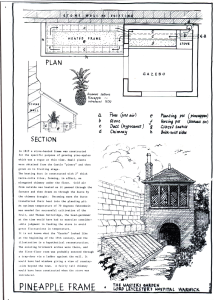
A Pineapple Pit is a way to grow Pineapples in colder environments such as here in Warwick. Although, it would have removed the cost of transporting the fruit from South America, the cost to maintain the environment needed to grow it would have been equally expensive. Nonetheless, this method was used by the Brethren of The Lord Leycester Hospital to grow and to rent out Pineapples.
However, with the invention of the steam ship, the Pineapple Pit became obsolete. Travelling abroad became easier and could be accomplished in less time. This brought down the price of such exotic goods and caused the English grown Pineapple to die off.
This was until, one such pit was unearthed in Cornwall at the The Lost Gardens of Heligan in 1991. Following this, there came the long work of reviving the England grown pineapple. The first was harvested in 1997 and the second was given to Queen Elizabeth II for her 50th wedding anniversary (https://www.heligan.com/news/the-story-of-the-10-000-pineapple/). Since then, they have continued to grow more Pineapples, refining the system each time with support of their volunteers. To this day, it is the only functioning Pineapple Pit in England, but is it a matter of time that more are brought back?