
Unboxing the Past: Interning in the Lord Leycester Archives
Foreword
This blog post was part of the Lord Leycester Archive & Collection internship project. This was written by Simran Mann of the University of Birmingham after a ten-week placement at the Lord Leycester, as a reflection on working through the onsite archival collection. The post reflects the author’s experience during this placement and what she had taken from this experience. Historical notes and annotation have been added by the Lord Leycester to provide further context for topics discussed. The archival material covered in this piece is still undergoing cataloguing, digitisation, and research. Some transcriptions and interpretations remain subject to further study and verification.
Unboxing the Past: Box A11 at the Lord Leycester
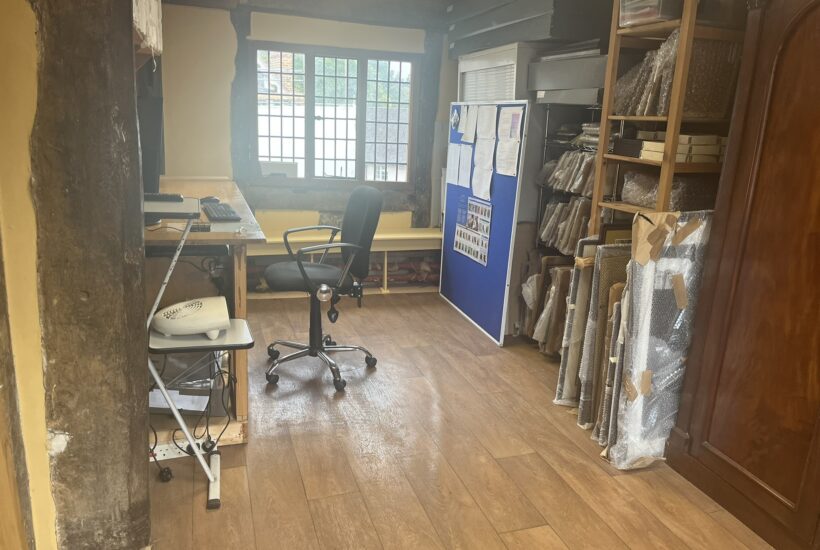
During my ten-week placement at the Lord Leycester[1], I undertook a project to audit and digitise the contents of a single archive box, Box A11[2].
The box proved to hold a remarkably diverse collection, ranging from postcards and correspondence, to wartime photographs and family registers, each reflecting the rich history of Warwick and the Lord Leycester. The box held far more material than could be digitised in ten weeks, therefore I prioritised its letters and postcards, completing a considerable piece of the collection.
Why the ‘Hanging Gate’?
My favourite find was a letter dated 13 December 1914 (catalogue number WARLL 2020 80.37).
Written to Toovey[3] about the origin of the name “Hanging Gate”, it offers a valuable insight into the history of the Lord Leycester and its architecture. It was also the most difficult letter to decode, given the early 20th Century cursive hand, but, with the help of the Brethren[4], I managed to transcribe and digitise it appropriately.
Within the letter, Mr Kemp was trying to work out why the West Gate (beneath the Chapel of St James on the Lord Leycester site) was known colloquially as the ‘Hanging Gate’. He had found records calling the Chapel above it the ‘Hanging Chapel’. (Toovey appears elsewhere in the box too: he received letters in 1910 and 1917, and a later letter from around 1925 debates the history of the buildings, so he seems to have been closely involved in recording the Lord Leycester’s past.)
The letter contained a theory that the name came from the quarters of people who had been hung and drawn being displayed on the gate. To check, he wrote to a man named William Hope. Hope’s reply (which Kemp had enclosed) offered a more practical explanation. He wrote that the gate may simply have been named after the Chapel overhanging it. Kemp, however, remained unconvinced by this explanation. More than a century later the question still remains unclear.
Next time you walk under the West Gate, look up at the Chapel above and decide for yourself which explanation you sway towards.
The Brethren’s Kitchen, 1880
One of the most charming stories in the box comes from a set of letters dated 2003. In the letter, Timothy Lloyd from Kent wrote to enquire about a painting that his parents had once owned: a watercolour called ‘The Brethren’s Kitchen’[5], painted by Elias Mollineaux Bancroft.
Lloyd explained how he had grown up with the painting and admired it, and how, a few years earlier, he had tracked down the very spot where it was painted – here in the Lord Leycester Kitchens. He explained how, after his parents died, the painting was to be sold at auction in London with an estimate of £2,000 to £3,000, and he wrote so that the Lord Leycester would have the chance to bring it home to Warwick.
The catalogue records that the painting was sold at auction but not that the Lord Leycester purchased it. If the painting ever found its way back to Warwick is a question I would love to find out.
A Family Register
One of the most moving items was a Family Register (WARLL 2020 34.1) recording the family of Edward William Cropper and Frances Wright[7], who married on 30 May 1861. In neat copperplate it lists the births of their children.
What makes the register useful to study Victorian history, are the notes squeezed into the margins: whooping cough, measles, chickenpox, scarlet fever, and even malarial fever in 1898 and 1899.[8] Together, these notes offer a glimpse into how vulnerable Victorian children were to disease, and how carefully one family recorded each illness they endured.
The Law in the Archive
As someone interested in law, I was struck by how often the law surfaced in this box, sometimes obviously and sometimes in the smallest details.
This was particularly relevant with the aforementioned Hanging Gate Letter, which reflected punishment as a public message. Kemp’s theory about the Hanging Gate rests on the punishment for high treason, with the remains displayed in public places as a warning to others. Whether true or not, this is a reminder of what was believed the law once was: relying on spectacle and fear. This is in stark contrast compared to far more modern legal documentation in Box A11. For example, a 1992 letter from Warwick District Council explaining that running unregistered food premises would become a criminal offence under the Food Safety Act (1990).
From medieval punishments to modern regulation, Box A11 taught me how law is woven into the historical record, shaping not only the lives of the people in these documents but also how their stories can be preserved and shared today.
Reflections
After reflecting on my ten weeks working at the Lord Leycester, this digitisation project taught me how much cataloguing matters. A clipping first recorded as having ‘no significance’ or an unsigned letter can turn out to connect to a family or even a centuries old local mystery.
Digitising these items means better accessed without risking damage to the originals and, hopefully, help bring the Lord Leycester a step closer to becoming an accredited museum. I hope the next student to take on this project enjoys uncovering the rest of Box A11 as much as I have.
Written by Simran Mann, 2026
Edited and Annotated by Jessica Hicks, 2026
Annotations
[1]Simran Mann was an intern at the Lord Leycester (a historic almshouse and museum) for ten-weeks in 2026, particularly working in the on-site Archives.
[2]This box had previously been categorised simply as “Miscellaneous” – as such the contents was not yet well documented or organised.
[3]Henry Toovey was Master of the Lord Leycester from 1901-1922. During his tenure he oversaw the restoration of the Chapel Tower (1902-1904) and produced the first Visitor Guide of the Lord Leycester.
[4]The Brethren are the ex-servicemen who live in the Lord Leycester almshouse. Known as Brothers or Brethren, it is not a religious order but a brotherhood in arms. They each continue a legacy of the charity spanning 450 years.
[5]The Brethren’s Kitchen is one of the rooms accessible to the general public at the Lord Leycester. It was once the main social room for the Brethren.
[6]The relationship between Edward and Frances Cropper’s family and the Lord Leycester is currently unclear.